
Signal Reliability Decoded: Why Sub-GHz 433MHz Beats 2.4GHz Wi-Fi in Wireless Lighting Controls
Signal Reliability Decoded: Why Sub-GHz 433MHz Beats 2.4GHz Wi-Fi in Wireless Lighting Controls
In smart home architecture, raw radio frequency propagation mechanics dictate whether your wall switch fires instantly or drops commands behind concrete walls.
When selecting a wireless light control system, homeowners and electrical contractors frequently focus on software interfaces while overlooking RF signal physics. A switch can feature the most sophisticated cloud ecosystem, but if its radio packet cannot penetrate thick residential building materials, lighting control fails.
According to spectrum allocation regulations governed by the Federal Communications Commission (FCC) and European telecommunication standards defined by the ETSI, Sub-GHz radio bands (such as 433MHz and 868MHz) offer superior physical transmission characteristics compared to congested 2.4GHz consumer Wi-Fi channels.
The Physics of Wavelength Penetration: Longer Waves, Stronger Through-Wall Signals
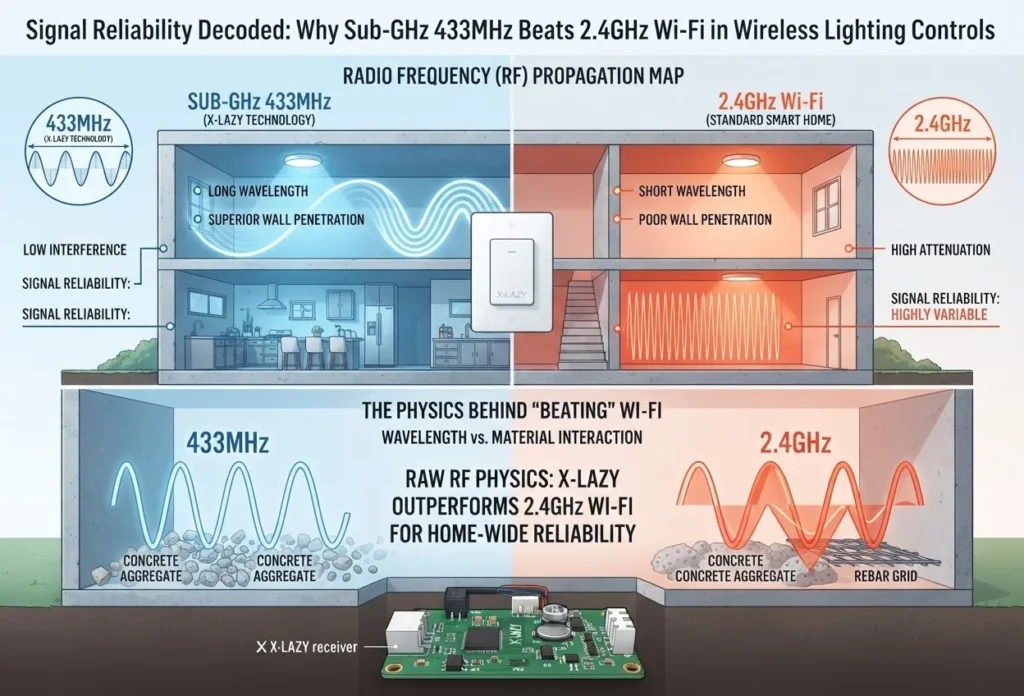
Radio wave propagation follows fundamental electromagnetic physics: lower radio frequencies correspond to longer physical wavelengths. Long wavelengths wrap around structural obstacles and experience significantly lower RF attenuation when passing through solid materials.
Physical Wavelength. Effortlessly penetrates brick, concrete, timber, and glass up to 30m indoors.
Physical Wavelength. Suffers heavy signal absorption from drywall, metallic studs, and water pipes.
Comprehensive signal propagation benchmarks published by the National Institute of Standards and Technology (NIST) quantify how common structural building materials absorb high-frequency electromagnetic energy:
Comparison of RF signal loss per barrier layer (Higher dB loss = weaker signal):
Bypassing 2.4GHz Spectrum Congestion and Packet Collisions
Modern homes are flooded with 2.4GHz wireless activity. Wi-Fi routers, Bluetooth audio devices, baby monitors, microwave ovens, and neighboring smart devices all compete within the identical 2.4GHz frequency band. This results in heavy packet collisions, latency spikes (100ms - 2000ms), and occasional command drops.
In contrast, self-powered micro-kinetic switches operate on dedicated Sub-GHz frequencies. When pressed, the internal generator broadcasts an ultra-fast, encrypted 433MHz RF burst lasting under 10 milliseconds. Because the Sub-GHz spectrum is clean and uncluttered, the receiver relay responds instantly without buffer delays.
| Performance Metric | X-Lazy Kinetic 433MHz Sub-GHz | Standard 2.4GHz Wi-Fi Switch |
|---|---|---|
| Indoor Penetration Range | Up to 30 Meters (3+ Solid Walls) | 10 - 15 Meters (Degrades fast through masonry) |
| Signal Latency | < 10 ms (Instantaneous) | 150ms - 2,000ms (Network dependent) |
| Router / Internet Dependency | Zero (100% Direct RF Pairing) | Requires active Wi-Fi & Cloud Server |
| Power Consumption | 0.00 Watts (Self-Powered) | 0.5W - 1.5W Continuous Idle Grid Draw |
Zero Network Vulnerability: Local Hardware-Level RF Pairing
Beyond physical range advantages, Sub-GHz kinetic switches operate entirely on a local hardware protocol. There are no IP addresses, no firmware updates to manage, and no exposure to external cloud server downtime or router resets.
To explore how micro-kinetic generators capture physical touch and convert it into electricity, read our foundational physics breakdown: How Micro-Kinetic Energy Harvesting Works: The Physics Behind Battery-Free Smart Switches.
Experience Unshakeable Sub-GHz Wireless Controls
Upgrade your property to ultra-reliable, wall-penetrating kinetic switches that never drop signal.
Explore Sub-GHz Kinetic Switch Kits →

