Preserving Structural Aesthetics: The Architect’s Guide to Non-Invasive Wireless Lighting Controls in Historic & Modern Buildings
Preserving Structural Aesthetics: The Architect’s Guide to Non-Invasive Wireless Lighting Controls in Historic & Modern Buildings
A comprehensive architectural guide on integrating zero-impact, battery-free lighting controls across sensitive materials, structural masonry, and high-end minimalist interiors.
Architectural lighting design is fundamentally about balancing aesthetic intent with functional spatial control. However, when executing lighting retrofits in protected historic buildings or high-end modern residences featuring exposed concrete, floor-to-ceiling glass, and custom joinery, conventional electrical installations present severe structural challenges.
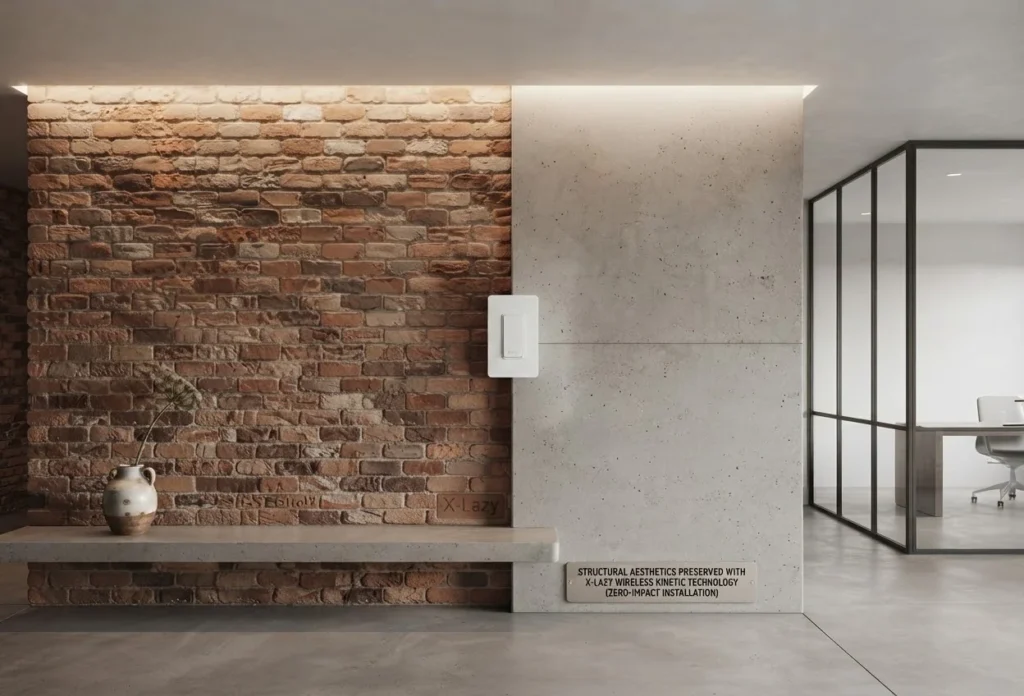
Chasing wire channels into historic plasterwork, exposed masonry, or marble wall facings compromises structural integrity, risks permanent material damage, and inflates contractor labor budgets by up to 60%.
According to heritage restoration standards published by the U.S. National Park Service (NPS) and conservation guidelines from the Royal Institute of British Architects (RIBA), non-invasive mechanical and electrical interventions are strongly mandated to preserve original building fabrics.
Material Compatibility Matrix: Traditional Conduit vs. Kinetic Surface Mount
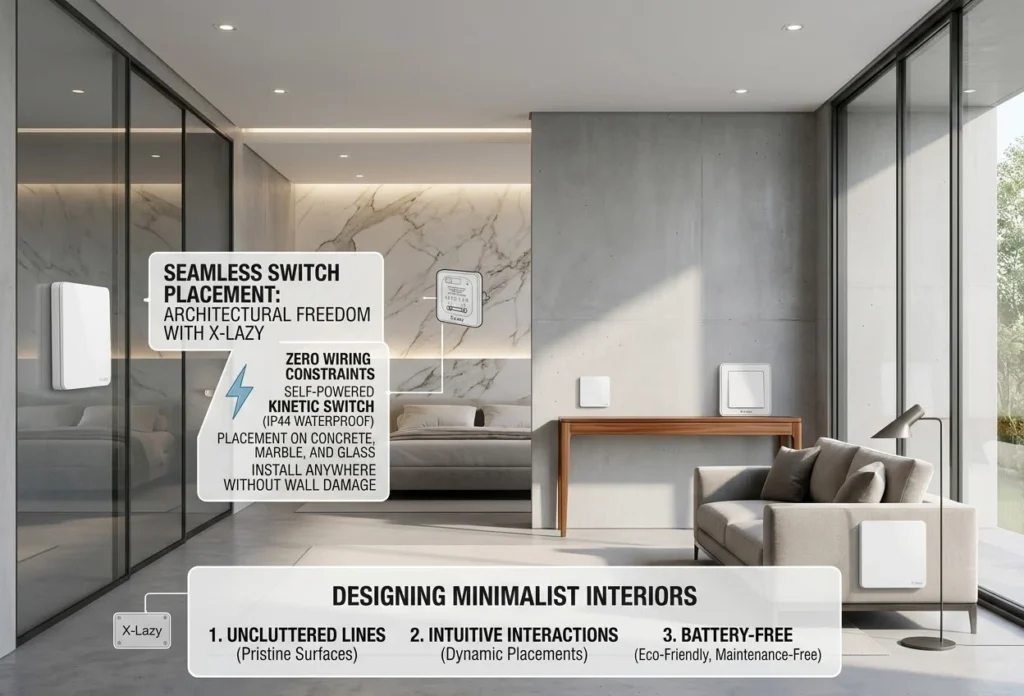
Architects specifying control switches across contemporary architectural finishes must evaluate surface integrity, installation risk, and long-term maintenance requirements:
| Architectural Material | Traditional Wire Chasing Risk | X-Lazy Kinetic Wireless Integration | Structural Impact Level |
|---|---|---|---|
| Tempered Glass Partitions | Impossible without exposed raceways | Direct 3M surface adhesive mounting | Zero (0% Impact) |
| Exposed Structural Concrete | High cost, visible conduit channels | Ultra-thin switch plate surface mount | Zero (0% Impact) |
| Historic Lath & Plaster | Cracking & historic fabric loss | Ceiling receiver + surface kinetic switch | Zero (0% Impact) |
| Solid Hardwood / Veneer Joinery | Permanent back-box routing holes | Flush surface adhesive integration | Zero (0% Impact) |
Architectural Specification Pillars for Zero-Impact Lighting Control
When specifying wireless controls in luxury residential or heritage projects, architects should ensure the hardware meets four technical pillars:
Commercial and luxury residential clients reject battery-operated remotes that require battery replacements or cause sudden service calls. Micro-kinetic harvesting ensures 50+ years of maintenance-free operation.
Sub-GHz 433MHz signals penetrate thick masonry and stone walls up to 30 meters indoors, far outperforming congested 2.4GHz Wi-Fi signals in historic stone properties.
Ultra-slim faceplate profiles integrate seamlessly into contemporary minimalist interiors, aligning flush with timber paneling, glass partitions, and stone tiles.
"Sustainable design requires holistic lifecycle planning. Adopting battery-free wireless controls protects both original architectural elements and long-term building energy performance."
Implementation Case Study: Integrating Micro-Kinetic Relays
To achieve a seamless non-invasive installation, electrical contractors install a single compact X-Lazy receiver relay inside the lighting ceiling rose or fixture junction box where grid power resides. Self-powered kinetic wall switches are then placed anywhere within the room—on bed headboards, glass doors, or kitchen islands—communicating wirelessly with sub-10ms latency.
Want to see how kinetic switches resolve multi-location staircase layouts without running traveler wires? Read our complete technical guide: How to Create a Multi-Location Light Control System Without Extra Wiring.
Architectural & Professional Design Trade Inquiries
Request technical specifications, CAD documentation, and sample kits for your next residential or commercial project.
Contact X-Lazy Architectural Trade Team →