Top 5 Battery-Free Kinetic Wireless Light Switches in 2026: An Engineering-Grade Comparison
Upgrading home lighting without running new wires inside drywall has become a standard approach for modern remodeling. However, chosen solutions often split into two camps: conventional smart switches that require neutral wires and replace internal relays, or self-powered kinetic switches that eliminate both batteries and wall tearing. In this engineering-focused guide, we evaluate the top 5 battery-free kinetic wireless switch systems in 2026 based on kinetic harvest efficiency, wireless transmission specs, receiver load ratings, and enclosure dimensions.
Quick Comparison: Key Technical Specifications
The table below summarizes the core hardware parameters of leading self-powered kinetic wireless lighting systems:
| Brand / Model | Wireless Protocol | Operating Frequency | Receiver Dimensions | Rated Current (Resistive) | Transmitter Pairing Capacity |
|---|---|---|---|---|---|
| X-Lazy Home 305JS Kit | RF Sub-1GHz | 433.92 MHz | 49 x 48 x 23 mm | 10A AC (Max 16A) | Up to 10 switches per receiver |
| RunLessWire Basic Kit | EnOcean / RF | 902 MHz (US) / 868 MHz (EU) | 82 x 54 x 28 mm | 5A AC | Up to 30 switches |
| Quinetic Wireless Switch | RF Sub-1GHz | 433.92 MHz | 50 x 50 x 25 mm | 10A AC | Up to 10 switches |
| RunLessWire Click (Philips Hue) | Zigbee Green Power | 2.4 GHz | N/A (Requires Hue Bridge) | N/A (Software Control) | System Dependent |
| Tunto EnOcean Switch | EnOcean | 868.3 MHz | 52 x 45 x 26 mm | 8A AC | Up to 8 switches |
How Kinetic Energy Harvesting Works in Lighting Control
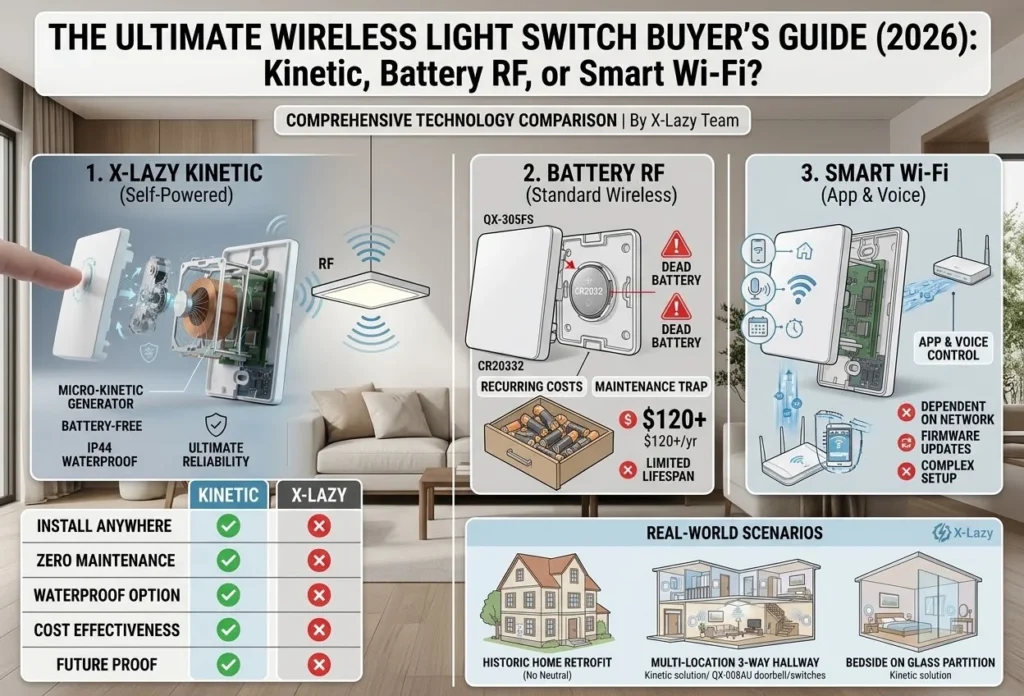
Kinetic switches do not rely on lithium coin batteries or mains electrical wiring at the wall box. Instead, they operate on miniature electro-mechanical generators built directly behind the rocker button. You can explore more about the underlying physics on our dedicated how it works page.
- Mechanical Actuation: When a user presses the wall switch, finger pressure applies mechanical force to a spring-loaded micro-actuator.
- Electromagnetic Induction: The motion rapidly moves a tiny neodymium magnet through an internal copper coil winding, generating a instantaneous micro-watt electrical pulse (Faraday's Law of Induction).
- RF Signal Transmission: This generated micro-watt power instantly energizes an ultra-low-power RF transmitter module, broadcasting an encrypted signal frame (such as 433.92 MHz) within microseconds before the pulse dissipates.
- Relay Execution: The hardwired receiver installed at the light fixture captures the RF frame, toggles its internal mechanical relay (or solid-state switch), and updates the circuit state.
Detailed Evaluation of Top 5 Kinetic Wireless Switch Systems
1. X-Lazy Home 305JS Kit (Best Value & Compact Receiver)
The X-Lazy Home 305JS Kit focuses on solving space constraints inside standard electrical junction boxes. Measuring just 49 x 48 x 23 mm, the 305JS receiver fits behind existing ceiling light fixtures or shallow junction boxes without requiring custom drywall cutouts. You can also browse our full range of system kits and single item collections to find matching multi-gang configurations.
- Frequency Stability: Operating at 433.92 MHz Sub-GHz RF, it achieves effective wall penetration through concrete and wooden studs, providing an indoor range of up to 30 meters and outdoor line-of-sight range up to 100-150 meters.
- High Current Threshold: Rated at 10A continuous AC current with an upper limit of 16A, it safely accommodates high-inrush LED drivers and traditional incandescent loads.
- Multi-Point Pairing: A single 305JS receiver can memorize up to 10 distinct kinetic transmitter switches, allowing effortless multi-location (2-way, 3-way, or multi-way) lighting control without running switch wires between locations.
2. RunLessWire Basic Kit (Best for Heavy US Commercial Installations)
Designed primarily for North American commercial and residential projects, RunLessWire utilizes the EnOcean protocol operating at 902 MHz. While the switch unit is robust and offers extensive switch pairing capacity (up to 30 switches), the receiver module (82 x 54 x 28 mm) is substantially larger, requiring dedicated gang boxes during retrofit installs.
3. Quinetic Wireless Switch (Popular in UK & European Retrofits)
Quinetic offers a wide range of 433MHz kinetic products widely adopted across the UK. Similar to X-Lazy Home, its receiver design is compact (50 x 50 x 25 mm) and supports 10A resistive loads. However, international distribution can involve higher shipping costs outside Europe.
4. RunLessWire Click for Philips Hue (Best for Ecosystem Smart Bulbs)
Unlike standalone switch-and-receiver hardware kits, the RunLessWire Click leverages Zigbee Green Power at 2.4 GHz. It does not wire directly to a light fixture; instead, it communicates natively with a Philips Hue Bridge to control smart color-changing bulbs via software logic.
5. Tunto EnOcean Switch (Architectural & Design-Focused)
Tunto targets high-end European architectural installations using 868.3 MHz EnOcean modules. It features premium materials like natural wood veneer faceplates, though it carries a premium price point suited primarily for luxury commercial renovation.
Key Buyer Checklist for Kinetic Wireless Switches
Before purchasing a battery-free wireless switch kit for your remodeling project, verify these three crucial parameters:
- Receiver Physical Volume: Ensure the receiver depth does not exceed 25 mm if you intend to fit it directly inside a standard wall box behind a light fitting.
- Inrush Current Tolerance: LED bulbs generate high temporary inrush currents when turned on. Look for receivers rated for at least 10A resistive or explicitly certified for LED lighting loads.
- Frequency Selection: Sub-GHz frequencies (433.92 MHz or 868/902 MHz) provide significantly superior wall penetration compared to 2.4 GHz signals in thick masonry or multi-story structures.
Frequently Asked Questions (FAQ)
Q1: Do kinetic wireless switches require Wi-Fi or an Internet connection to work?
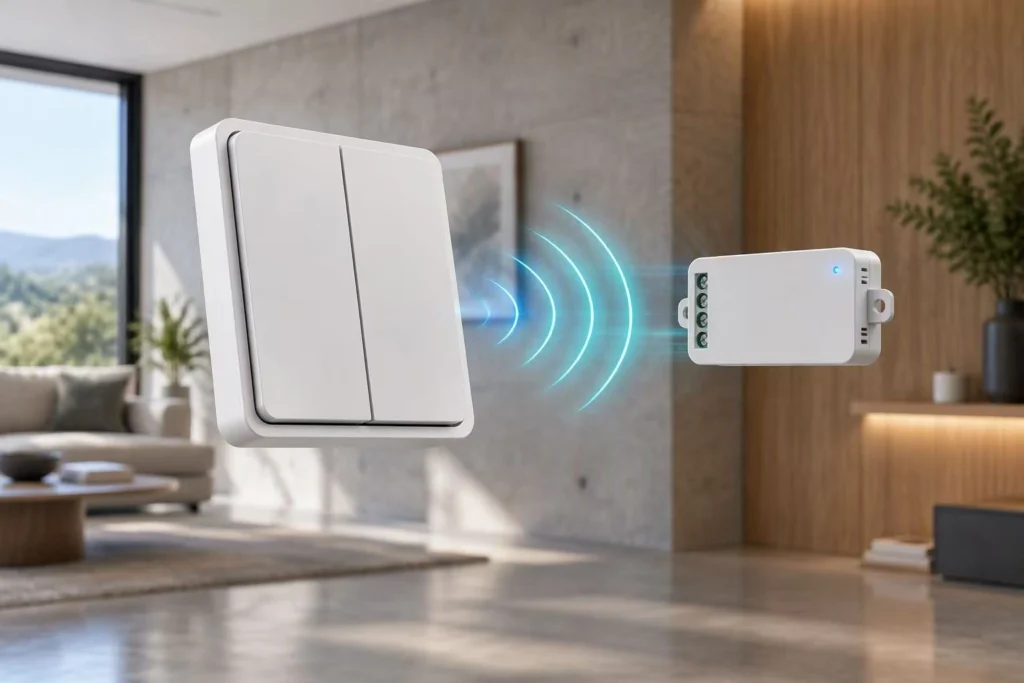
Answer: No. Standard RF kinetic switch kits (like the X-Lazy Home 305JS Kit and Quinetic) operate via direct Sub-1GHz RF pairing between the kinetic switch and the wired receiver. They do not require Wi-Fi, internet routers, or cloud servers to switch lights on or off.
Q2: Does the receiver part of a kinetic switch kit require batteries?
Answer: No. The switch/wall plate is 100% battery-free, but the receiver unit must be hardwired into the AC power line (AC 110-250V) near the light fixture to switch the circuit on and off.
Q3: Can I create a 3-way or 4-way light switch setup without extra wiring?
Answer: Yes. By pairing multiple kinetic switch transmitters (e.g., 2 or 3 switches) to a single receiver (such as the 305JS receiver), you can control one light fixture from multiple locations in the house without running switch wires between them.