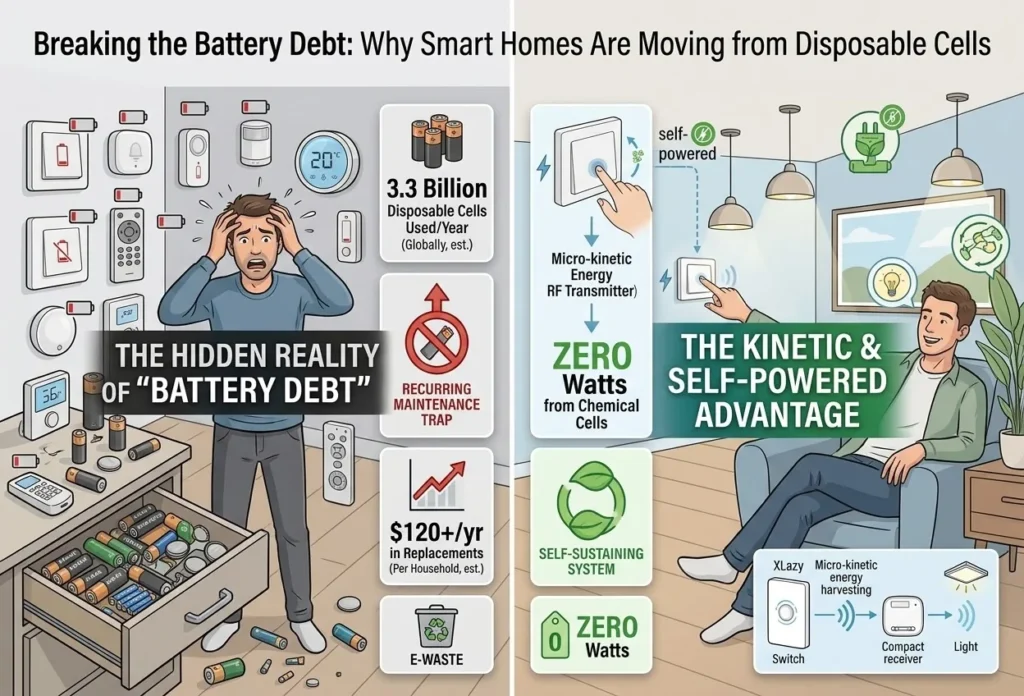
The Financial and Environmental Toll of “Convenience”
The Financial and Environmental Toll of “Convenience”: Auditing The Battery Debt
When we initially transition into modern smart home automation, the sticker price of individual sensors and switches presents itself as an affordable entry ticket to seamless luxury. However, beneath the polished exterior of app-controlled ambient lighting and automated climate control lies an insidious, compounding friction: The Battery Debt. Every single-use chemical cell embedded within your living space represents an unwritten agreement—a continuous commitment of your time, financial resources, and cognitive peace to maintain a temporary energy infrastructure.
Consider the typical architecture of a multi-room smart estate. To achieve comprehensive coverage, a household routinely deploys thirty to fifty connected endpoints—ranging from motion detectors and door contact sensors to humidity monitors and localized controllers. A standard setup often relies on a high-density array of wall controllers. Replacing a traditional physical toggle with a conventional wireless smart controller means introducing a ticking clock into your walls. Over a two-to-three-year window, these chemical cells degrade asynchronously. What promised to be an effortless system devolves into an ongoing maintenance routine characterized by low-battery notifications, unexpected systemic drops, voltage troubleshooting, and tedious store trips for specialized lithium coin cells.
By rethinking room control through a self-powered battery free wireless switch or an adaptable no wire light switch, modern architecture eliminates this recurring maintenance loop entirely. Instead of managing battery life cycles room by room, homeowners can re-establish a stable, zero-upkeep control grid.
Quantifying the Economic Friction of Chemical Storage
The true financial expenditure of traditional smart home ecosystems goes far beyond the initial hardware invoice. The primary cost drivers contributing to total cost of ownership (TCO) include:
- Recurring Consumable Expenses: Specialty lithium batteries (such as CR2032, CR123A, or AA lithium cells) carry high per-unit replacement costs. Replacing dozens of cells across a smart property every 12 to 18 months generates a perpetual subscription fee merely to keep basic wall controls operational.
- Cognitive Overhead & Labour Costs: In large residential projects or boutique hospitality environments, the labor required to audit voltage, unmount wall plates, swap cells, and re-pair wireless mesh nodes represents a significant sink of time and maintenance expenditure.
- Systemic Downtime Risks: When a battery depletes silently, critical automation rules fail—leaving security perimeters unmonitored or interior lighting unresponsive until manual intervention occurs.
Adopting a self-reliant kinetic infrastructure—such as installing a versatile wireless wall switch or an outdoor rated control point—ensures that power generation happens synchronously at the exact moment of user intent, shielding your home from unpredictable power failures.
The Ecological Reality: E-Waste and Heavy Metal Pollution
While the personal friction of managing dead batteries is frustrating, the environmental footprint of disposable chemical energy in home automation is alarming. Modern smart homes are unwittingly accelerating a global environmental crisis under the banner of “sustainable living.”
According to comprehensive waste statistics highlighted by the U.S. Environmental Protection Agency (EPA), billions of single-use and rechargeable batteries enter municipal waste streams each year, with less than 20% undergoing formal recycling processes. Global research published by the United Nations Environment Programme (UNEP) emphasizes that electronic waste (e-waste) remains one of the fastest-growing hazardous streams on earth.
The lifecycle hazards of relying on disposable batteries in smart home installations include:
- Landfill Leaching and Toxic Oxidation: When spent lithium, alkaline, or nickel-cadmium batteries are sent to municipal landfills, mechanical compaction corrodes their outer casings. Over time, heavy metals and toxic electrolytes leach into surrounding subsoil and groundwater systems, posing long-term ecological hazards.
- Resource-Intensive Extraction: The production of single-use cells demands intensive raw material extraction—including cobalt, lithium, and rare earth elements. Mining these materials requires significant water usage and energy expenditure, often accompanied by severe environmental degradation at the point of origin.
- High Embodied Carbon Footprint: Manufacturing, packaging, and globally distributing billions of micro-batteries—only for them to serve a brief operational life before disposal—creates an inherently unsustainable carbon lifecycle that contradicts modern eco-friendly architectural goals.
The Energy Harvesting Paradigm: Physics Over Chemistry
To break free from chemical dependency, modern engineering must shift away from energy storage and turn toward continuous micro-power harvesting. Ambient environmental physics offers an abundant, untapped power grid right inside our living spaces.
As documented by industrial research standards from the Institute of Electrical and Electronics Engineers (IEEE) and implemented by global trade groups like the EnOcean Alliance, micro-energy harvesting captures ambient physical forces and converts them directly into ultra-low-power radio signals:
- Kinetic Energy Conversion: The simple mechanical force of a human finger depressing a light switch generates an electro-dynamic reaction. This physical movement produces enough instantaneous milliwatts to transmit a secure RF signal to a receiver, requiring zero chemical storage or external wiring.
- Photovoltaic Harvesting: Advanced indoor amorphous silicon panels absorb diffuse indoor architectural light, storing micro-joules in solid-state buffers or long-life supercapacitors to sustain multi-room sensor networks continuously through dark periods.
Deploying an integrated system like a self-powered kinetic wireless switch kit or a pre-paired wireless light switch and receiver kit allows homeowners to convert raw physical interaction into instantaneous, maintenance-free digital control.
Architectural Freedom and Sustainable Luxury
Eliminating batteries does more than protect the environment—it unlocks unprecedented flexibility in interior architectural design. Traditional wired controls tie switch placement directly to electrical junction boxes, requiring destructive wall channeling, copper wiring runs, and complex rewiring during renovations.
By utilizing a versatile wireless remote control light switch architecture, designers and homeowners can position switches on glass partitions, exposed concrete walls, marble kitchen islands, or historic timber paneling without running a single conduit. Furthermore, configuring multi-location controls—such as a wireless 3 way light switch arrangement across multi-story staircases or expansive corridors—becomes a simple, tool-free process that bypasses complex multi-wire travel runs entirely.
At X-Lazy Home, we build sustainable home automation around a core design philosophy: Create, Never Consume. By combining kinetic force transducers with intelligent micro-receivers, our hardware architecture enables you to pay off your battery debt permanently—establishing a quiet, beautiful, and truly zero-maintenance living environment. To explore the exact engineering principles powering our self-sustaining systems, visit our [How It Works] documentation.
With a quieter rhythm, Founder of Xlazy Home.