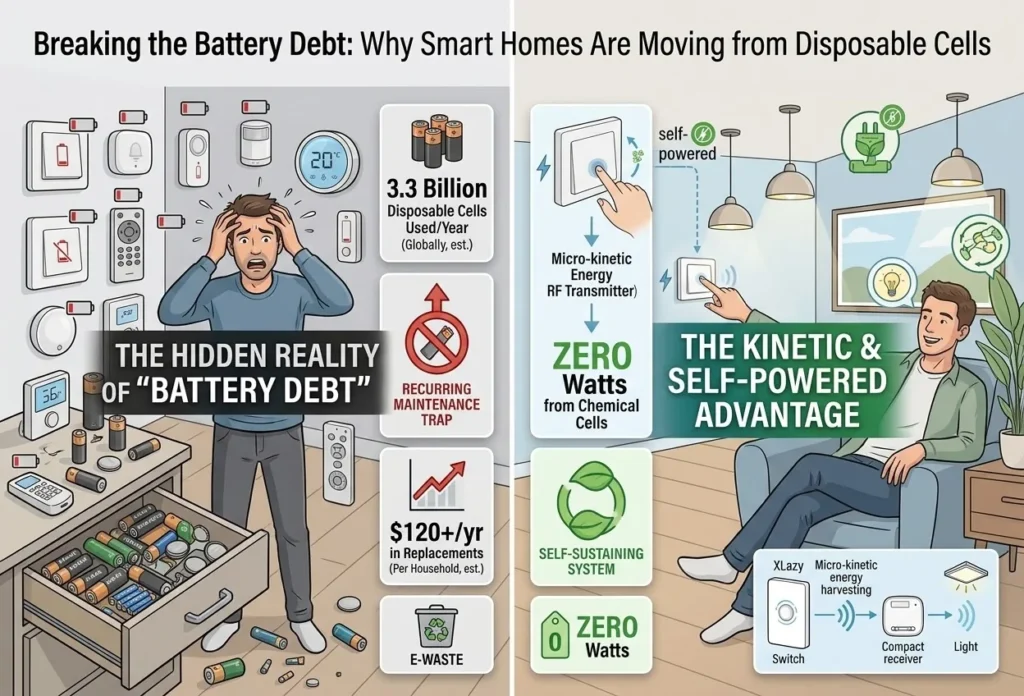
The Midnight Failure: Why Smart Switch Batteries Always Fail When You Need Them Most
The Midnight Failure: Why Smart Switch Batteries Always Fail When You Need Them Most
It usually happens at the worst possible moment: You walk into a dark hallway late at night, press your wireless light switch, and nothing happens. No light, no click, just total silence. After tapping the button five times in frustration, you realize your “convenient” smart home controller has quietly run out of power.
This scenario highlights the core frustration of smart switch battery replacement problems. While wireless smart home devices offer incredible flexibility during installation, they introduce a hidden layer of continuous maintenance. What begins as a seamless upgrade quickly turns into a endless cycle of troubleshooting, dead coin cells, and unexpected device downtime across your household.
The Science Behind Sudden Battery Dropouts
Why do battery-powered switches and sensors seem to fail suddenly without any advance warning? The answer lies in the specific discharge voltage curve of modern lithium coin cells (such as CR2032 and CR2450).
Unlike standard alkaline AA batteries—which experience a slow, steady voltage drop over time—lithium coin cells maintain a near-flat voltage curve at 3.0 Volts for 90% of their operating life. However, once chemical reactants inside the cell reach depletion, the voltage plunges off a cliff overnight.
A CR2032 coin cell will output a stable ~3.0V for months, showing 100% to 80% battery status in your smart home app. But once internal voltage drops past 2.6V, the wireless RF transmitter loses peak transmission power. Within days, the battery drops below 2.0V, causing the switch to drop offline instantly without warning.
Compounding this problem is ambient temperature sensitivity. According to battery chemical safety guidelines from the Sandia National Laboratories Energy Storage Systems Program, low temperatures reduce internal ion mobility in lithium chemistry. When your home cools down overnight, an already-weak battery drops below operational threshold, causing switches in garages, hallways, and exterior entryways to fail precisely when ambient light is lowest.
The Real-World Frustrations of Smart Home Maintenance Fatigue
Dealing with dead batteries isn’t just a minor inconvenience; it disrupts the basic functionality of your living environment. Over time, smart switch battery issues manifest in four major operational pain points:
1. The Micro-Screwdriver Search
Replacing a coin-cell battery inside an ultra-slim switch plate rarely involves a tool-free latch. To comply with international safety standards regarding child ingestion hazards—such as those published by the U.S. Consumer Product Safety Commission (CPSC)—manufacturers lock battery compartments behind microscopic Phillips head screws. Finding a precision screwdriver at 11 PM to fix a light switch is a frustrating chore.
2. Toxic Battery Corrosion and Leaks
When battery-powered switches sit idle in humid environments like bathrooms, outdoor patios, or laundry rooms, micro-condensation builds up inside sealed housings. Over time, spent battery cells rupture, leaking potassium hydroxide or lithium salts directly onto micro-circuitry. This chemical corrosion permanently ruins the device, turning a simple battery swap into a full replacement purchase.
3. Network Mesh Disruption
In mesh-based automation protocols (like Zigbee or Z-Wave), battery-powered endpoint switches rely on constant polling to communicate state changes. When a switch battery dies, smart home hubs continuously retry failed handshake signals, draining the batteries of adjacent wall sensors and causing full automation routines to lock up.
4. The Forgotten Stock Trap
Smart home controllers use various coin-cell sizes (CR2032, CR2450, CR2016, or CR123A). Most households do not keep fresh stock of four different battery form factors. When a switch dies, you either make a late-night trip to the supermarket or order replacements online, leaving your room dark for days.
This cumulative friction is why so many homeowners end up removing battery switches entirely, as discussed in our investigation on the invisible tax on smart homes.
Kinetic Energy Harvesting: Eliminating the Battery Maintenance Loop
The solution to battery maintenance fatigue is not building a “better battery”—it is removing the battery completely from the switch assembly. Modern kinetic micro-energy harvesting replaces chemical energy storage with real-time physical power generation.
[ Stored Chemical Energy ] ──► [ Voltage Decay ] ──► [ Intermittent RF Drop ] ──► [ Dead Battery / E-Waste ]
X-Lazy Kinetic Switch:
[ Physical Button Press ] ──► [ Micro Energy Generator ] ──► [ Instant RF Signal ] ──► [ Permanent Zero Maintenance ]
When you press a kinetic self-powered switch, the tactile pressure of your stroke drives a micro-magnetic coil assembly inside the switch body. This mechanical displacement produces an instantaneous micro-watt burst of electrical current—more than sufficient to encode and broadcast an encrypted RF command to the ceiling light receiver module up to 100 feet away.
Because there are no chemical components, kinetic switches offer distinct structural advantages:
- Immunity to Temperature Swings: Kinetic generators operate reliably from -40°F to 150°F (-40°C to 65°C), making them ideal for unheated garages, outdoor stone patios, and humid bathrooms.
- Zero Chemical Corrosion Risks: With no internal electrolyte liquids, sealed kinetic switches can never leak or ruin internal electronics.
- No Tools or Disassembly Ever: Once stick-mounted on drywall, wood, or glass, the switch plate remains untouched for its entire 30+ year service lifespan.
Comparing Long-Term Switch Reliability Across Home Built Environments
How do self-powered kinetic controls stack up against legacy battery switches across typical real-world installation challenges? The table below outlines operational performance across common installation scenarios:
| Scenario / Location | Battery Smart Switch (CR2032/CR2450) | X-Lazy Kinetic Self-Powered Switch |
|---|---|---|
| High-Humidity Bathrooms | High risk of terminal corrosion & rapid self-discharge. | 100% Sealed housing; zero chemical vulnerability. |
| Unheated Garages & Porches | Cold snaps cause sudden voltage collapse and signal dropouts. | Unaffected by freezing cold or extreme heat. |
| Hard Surface Mounts (Brick/Log) | Must be unmounted from wall adhesive to replace backplate battery. | Adheres permanently; never needs unmounting. |
| Multi-Way Staircase Controls | Desynchronizes when one switch battery dies before the other. | Both switches remain perpetually paired and ready. |
How to Transition Your Home to Maintenance-Free Lighting
Eliminating smart home maintenance fatigue doesn’t require complex rewiring or hiring an electrician. You can audit and upgrade your home lighting system in three practical steps:
- Audit Your “Battery Debt”: Count every battery-powered switch, sensor, and remote in your home. Multiply that number by $3.00 to calculate your annual recurring consumable cost.
- Replace Problematic Switch Points: Start with switches mounted on challenging surfaces—such as adding light controls to log cabin timber or brick walls—where removing plates to replace batteries is most annoying.
- Streamline Multi-Switch Circuits: Upgrade entryway and staircase lighting using kinetic kits, enjoying full 3-way control without traveler wires or battery compartments, as detailed in our guide on wiring wireless 3-way switches for indoor and outdoor setups.
By replacing chemical energy storage with micro-energy harvesting, you build a smart home that truly serves you—rather than one that constantly demands new batteries. Experience the peace of mind that comes with unplugged luxury and self-powered automation today.