
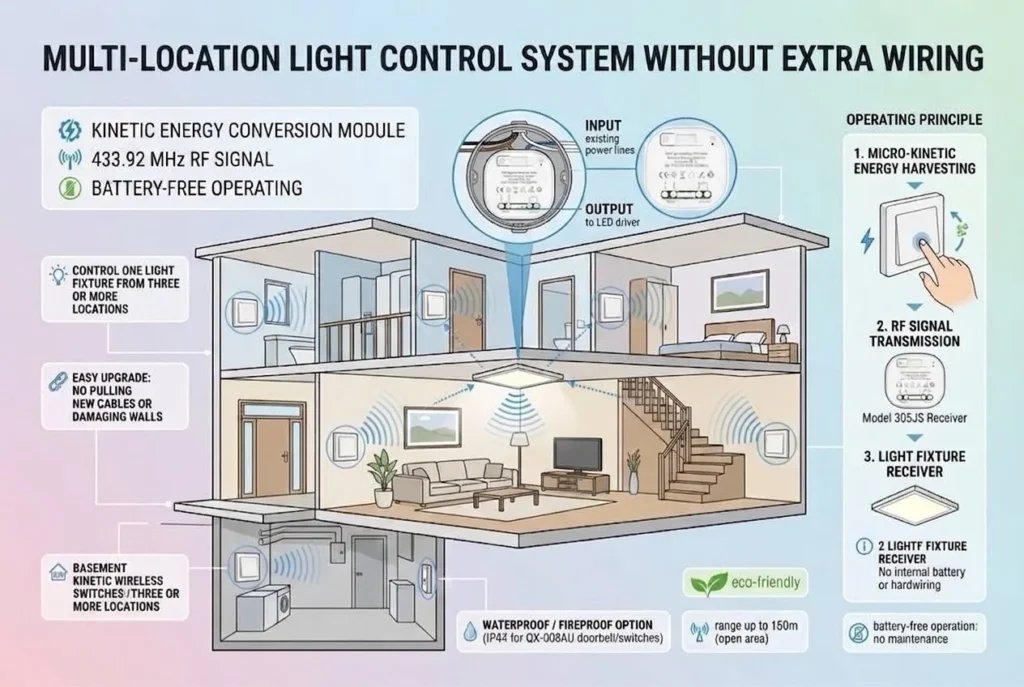
How to Create a Multi-Location Light Control System Without Extra Wiring
How to Create a Multi-Location Light Control System Without Extra Wiring
Controlling a single light fixture from three, four, or even more locations is a staple of comfortable living. Whether managing illumination across multi-story staircases, expansive open-concept living rooms, or long hallways connecting multiple bedrooms, multi-location switching provides seamless convenience. However, setting up a traditional multi-switch system is one of the most labor-intensive tasks in residential wiring.
According to facility management standards published by the U.S. General Services Administration (GSA), traditional 4-way and multi-location wiring setups require complex network configurations with 4-terminal switches and four copper travelers between every control point, drastically elevating installation labor and wall remediation costs.
Fortunately, battery-free micro-kinetic harvesting makes multi-location switching accessible to any homeowner or landlord without pulling new cables or damaging walls. In this guide, we break down why traditional multi-point rewiring is so difficult, compare retrofitting options, and walk you through setting up a wireless multi-location lighting network in minutes.
The Headache of Hardwired Multi-Location Switching
In standard electrical installations, controlling a light from two locations requires a 3-way switch pair. When you expand control to three or more locations, the complexity spikes exponentially:
- Intermediate 4-Way Switches: Every additional control point between the primary switches requires a special 4-way mechanical switch with four interconnecting terminals.
- Extensive Conduit & Wire Pulling: Four-conductor cables must physically run through joists, studs, and conduits across distant wall sections.
- Wall Cutting & Restoration: Retrofitting older homes without pre-existing traveler wires means cutting wide channels through drywall, plaster, or masonry.
Research on energy retrofits from the UK Department for Energy Security and Net Zero (DESNZ) highlights that non-invasive wireless controls reduce structural labor and electrical installation time by over 80% in residential updates.
Cost & Efficiency: Traditional 4-Way Wiring vs. Kinetic Wireless
| Feature | Traditional Hardwired 4-Way+ | Standard Battery-Powered RF | X-Lazy Kinetic Multi-Location |
|---|---|---|---|
| Switch Locations | Limited by physical wires | Up to 5-10 paired remotes | Unlimited paired switch points |
| Installation Cost | $300 – $700 (Electrician + Plaster) | $0 (DIY) | $0 (DIY in 15 mins) |
| Power Requirement | 120V / 230V Grid Line | CR2032 Lithium Batteries | Micro-Kinetic Generator (0W) |
| Maintenance Over Time | None (Until mechanical wear) | Battery replacement every 1-2 yrs | Zero maintenance (200,000+ clicks) |
How Kinetic Micro-Generators Enable Multi-Point Pairing
Unlike traditional circuits where physical switches mechanically route AC grid power, a wireless kinetic system separates power control from user input.
[ Bedside Switch B ] ──────┼──► (433MHz Signal Burst) ──► [ Receiver Relay ] ──► [ Fixture On/Off ]
[ Hallway Switch C ] ──────┘
When any kinetic switch button is pressed, internal spring mechanics press a micro-generator, harvesting microjoules of energy (μJ) from finger pressure. This instantly broadcasts a unique RF address. The receiver relay connected to the light fixture listens for these paired signals and toggles state instantly.
According to wireless propagation research from the National Institute of Standards and Technology (NIST), sub-GHz radio signals (such as 433MHz) pass reliably through standard residential building materials, including drywall, timber, and brick, up to 30 meters indoors.
Step-by-Step DIY Setup: Controlling One Light from Multiple Locations
Step 1: Install the Central Receiver Relay
Shut off main breaker power. Wire a single kinetic receiver relay inside the light fixture ceiling box or near the existing primary wall switch box. This single relay directly toggles power to the lamp load.
Step 2: Pair Multiple Kinetic Switches
Press the pairing button on the receiver relay for 3 seconds until the LED indicator flashes. Press your first kinetic switch—it pairs instantly. Repeat this quick step for your second, third, or fourth switch locations.
Step 3: Mount Switches Anywhere You Want
Peel the included 3M adhesive tape and place the switches wherever you need them: next to your bed, beside the front door, at the top of a staircase, or on glass room dividers. No back-boxes or wire holes required.
Conclusion: Effortless Flexibility for Complex Layouts
Creating a multi-location light control system no longer requires thousands of feet of copper wire, licensed electrician house calls, or destructive wall cutting. With self-powered kinetic switch kits, you can expand home light controls to as many locations as you want—quickly, safely, and with zero long-term battery maintenance.
To understand the core science behind battery-free harvesting, read our technical breakdown: How Micro-Kinetic Energy Harvesting Works: The Physics Behind Battery-Free Smart Switches.
Build Your Multi-Location Wireless Lighting Today
Control any light fixture from unlimited locations without running a single wire.


