
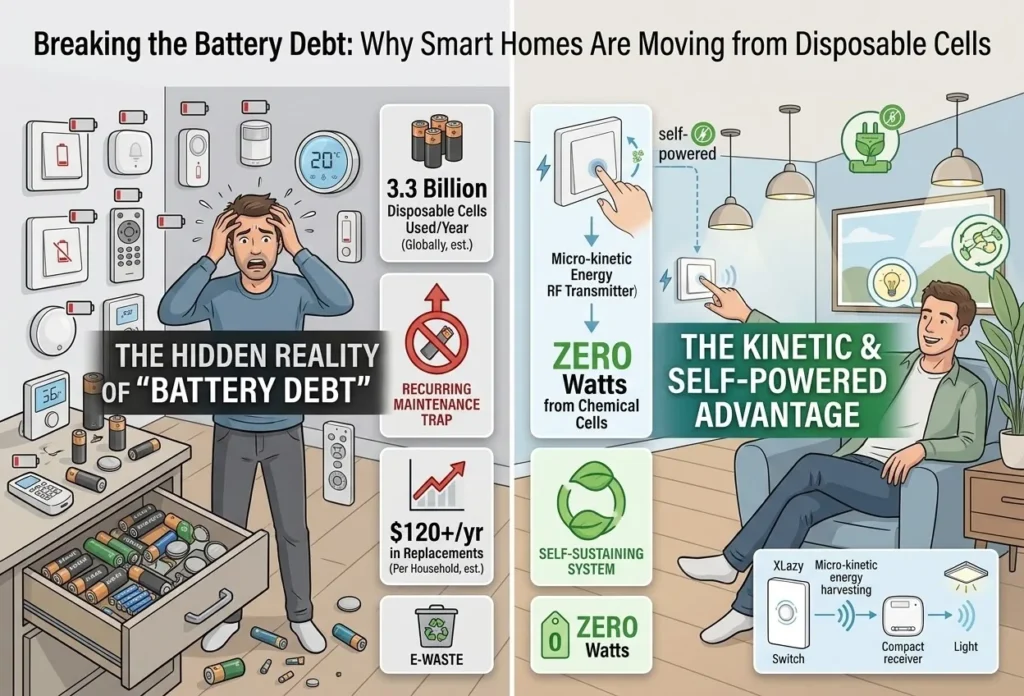
Breaking the Battery Debt: Why Smart Homes Are Moving Away from Disposable Cells
Breaking the Battery Debt: Why Smart Homes Are Moving Away from Disposable Cells
Every wireless sensor, remote switch, and smart gadget adds convenience—until the batteries start dying one by one. Welcome to the hidden reality of "Battery Debt."
Smart home technology promises automated ease, but behind the scenes, millions of households are falling into a recurring maintenance trap. Industry experts refer to this escalating cycle of maintenance, replacement costs, and e-waste as Battery Debt.
As regulatory bodies like the European Commission introduce stricter battery sustainability mandates, homeowners and builders are actively seeking permanent alternatives to coin-cell remotes and battery-operated IoT switches.
Understanding the True Cost of "Battery Debt"
Battery Debt isn't just about buying a pack of CR2032 or AA batteries at the supermarket. It impacts home reliability across three distinct dimensions:
- Financial Drain: High-drain wireless smart switches consume coin cells every 6 to 12 months, accumulating substantial recurring expenses over time.
- System Downtime: When a key switch battery dies overnight, hallway lighting, security triggers, or smart automation routines stop working immediately.
- E-Waste & Environmental Toxic Load: Lithium and alkaline cells leak toxic heavy metals into soil and water tables when mismanaged in residential garbage streams.
— Energy Efficiency Insights, National Renewable Energy Laboratory (NREL)
Frequently Asked Questions: Solving Battery Debt in Lighting
Micro-kinetic technology captures the mechanical force generated by a human finger pressing a light switch and converts it directly into a pulse of electrical energy. This instantaneous micro-watt power burst is sufficient to broadcast an encrypted RF command over long distances without any stored battery charge.
Standard RF remotes rely on chemical batteries that slowly degrade, even when unused. In contrast, X-Lazy kinetic switches utilize a mechanical generator engineered for over 200,000 presses—offering 30+ years of maintenance-free operation under daily residential use.
It takes less than 10 minutes. Simply wire a compact kinetic receiver behind your existing ceiling light fixture, pair the self-powered wall switch with a single click, and stick the wall plate anywhere using 3M adhesive tape—no back-box cutting required.
Eliminating Battery Debt: Hardwired vs. Battery vs. Kinetic
When upgrading or retrofitting residential switches, choosing the right power architecture determines your long-term maintenance workload:
- Hardwired Switches: Zero battery debt, but requires high electrician labor costs, wall cutting, and complex physical wiring.
- Battery RF Remotes: Low upfront labor, but creates perpetual battery debt, ongoing maintenance calls, and environmental e-waste.
- X-Lazy Kinetic Switches: Zero battery debt, zero structural wall damage, instant DIY setup, and lifetime maintenance-free performance.
To learn more about implementing multi-point control without running cables, check out our guide on How to Create a Multi-Location Light Control System Without Extra Wiring.
Stop Buying Replacement Batteries for Good
Pay off your home's battery debt today with self-powered kinetic switches that never run out of juice.
Upgrade to Battery-Free Kinetic Switches →

